
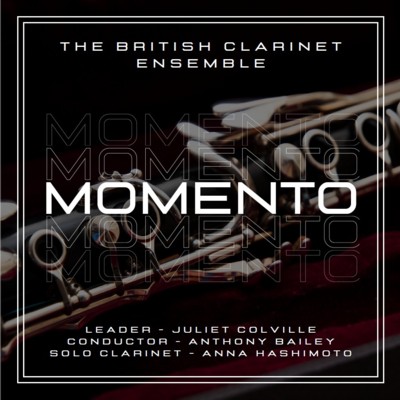
| “Momento” is the fourth album to be
released by the British Clarinet Ensemble and celebrates
the 30th anniversary of the ensemble which was formed in
1995. It is dedicated to Charles Hine, who died in 2024
and was our musical director from 1995 until illness
forced his retirement in 2022. Charles commissioned
eighteen compositions on behalf of the ensemble, all of
which the BCE have recorded. The BCE champions British
composers, regularly commissioning new works to enhance
the clarinet choir repertoire. The BCE has performed in
the UK |
||
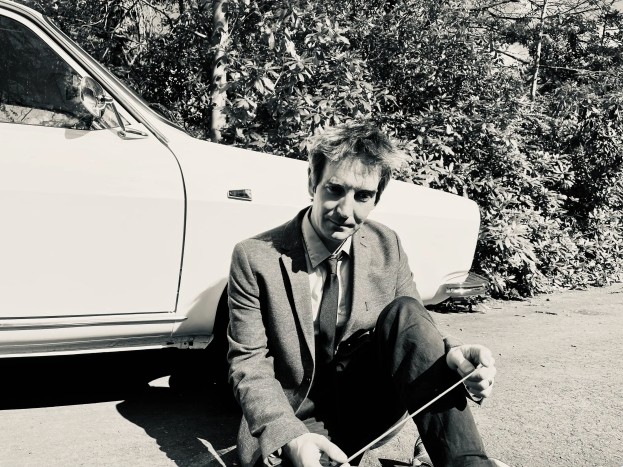
| Anthony Bailley is the musical director of the
British Clarinet Ensemble. | ||
 |
||
| As a clarinettist Anthony has played and recorded with
the London Mozart Players, Orchestra of the Age of
Enlightenment, the Orchestra of the Royal Opera House,
and the English Chamber Orchestra. He is a member of the
Chinook Clarinet Quartet, with whom he has regularly
performed throughout the UK in prestigious venues such as
the Wigmore Hall, Purcell Room, and the Bridgewater Hall.
The quartet have recorded two CDs and performed live on
BBC Radio and TV. As an education workshop leader, he has run projects for the London Mozart Players, the Orchestra of the Age of Enlightenment, and the Roman River Festival. As a composer, Anthony has written works for the National Youth Wind Ensemble of Great Britain, an SPMN commission for the BBC Singers, and two orchestral pieces for the Philharmonia orchestra, one of which was conducted by HRH The Prince of Wales. Anthony’s first opera The Black Monk (which he adapted himself from the Chekhov short story,) was premiered in 2003 to public acclaim by the Sirius ensemble at the Bloomsbury theatre in London. He is the Head of Woodwind at Wellington College, a woodwind coach and conductor for the National Children’s Orchestra of Great Britain and National Youth Orchestra and he conducts the City Lit Orchestra and runs music courses all over the country. He has been the conductor of the Symphonic Wind Orchestra and the Clarinet Choir at the Royal College of Music Junior department since 2004, where he also teaches the clarinet, many pupils have gone on to the national conservatoires. There are often several of Anthony’s pupils in the clarinet section of the National Youth Orchestra. |
||
| Stephen McNeff | ||
| 1-4 | The Darkling Serenade (Symphonic Study for Clarinet Ensemble) | 18’17" |
| © Maecenas Music | ||
| I first encountered the
word ‘darkling’ in the famous poem by Thomas
Hardy, ‘The Darkling Thrush’. In fact, the word
was used by Keats and simply means ‘in the
dark’, but Hardy uses it lyrically to describe an
impression of evening. Despite his image of “the
weakening eye of day” and, “an aged thrush,
frail, gaunt and small”, the sentiment is finally
optimistic: “…there trembled through his happy
good-night air some blessed Hope…” It was this series of reflections that inspired me to write a multi-movement work for clarinets. The predominantly dark-grained timbre of the ensemble as I heard it is capable of subtle changes in sound and mood – rather like the Thomas Hardy poem. They seemed a good match. Such an ostensibly simple poem structurally, also seemed like something to aim for musically. It contains surprises and is (I hope) unpredictable in some way. The work is in four movements and as I wrote I realised that it had symphonic-like features. These include the repetition and transformation of material and the use of cyclic fragments. I did not want to claim it as a symphony, but contented myself with the term ‘symphonic study’ (a term used by composers as diverse as Schumann and Elgar in different ways). It opens with a slow minor key introduction which leads to a faster and more florid main section. The second part is calmer and is a study in the transformation of material with some leaning towards a passacaglia-like structure. This moves without a break into a fast movement which has a grotesquely natured middle section and a final few bars which prepare us for the quiet of the last movement. The final part opens very quietly exploring the rich sonorities of the lower instruments while a relaxed melody liquefies overhead. Counter-melodies build to a homogenous declaration of this tune before winding down into an increasingly misty conclusion based on fragments of music heard earlier. By the way, I have never been very convinced about the ability of a description in programme notes to capture what music is really about except in a purely formal way. Even my own analysis, written after the music is complete, is as subjective as anyone else’s. I hope you will make up your own mind what the music says and means to you in your own way, just as you will do with Thomas Hardy’s poem. |
||
| Stephen McNeff was born in Ireland, brought up in Wales and educated at the Royal Academy of Music in London. After working as a music creator in theatre he became Composer in Residence at the Banff Centre in Canada. He is best known for his work in opera and theatre. His opera Clockwork based on the novel by Philip Pullman was seen at the Royal Opera House Linbury Theatre and the ROH commissioned Gentle Giant adapted from Michael Morpurgo’s book. He went on to be the first Royal Philharmonic Society/PRSF ‘Composer in the House’ with the Bournemouth Symphony Orchestra and this led to an increasing recognition of his versatility and adaptability in a wide range of genres. Equally at home in the concert hall or theatre, works like the operas Vivienne (2014), Banished (2016) and Beyond the Garden (2020) have enjoyed wide audiences both in the UK and abroad, while choral pieces for the BBC Singers and Chamber Choir Ireland sit alongside solo instrumental works and concertos for oboe, flute and, most recently, saxophone quartet. Hedd Wyn, his opera commissioned by Welsh National Opera for TV was released on CD in 2022, while his song cycle for tenor Gavan Ring and pianist Louise Thomas, Ballads of a Bogman, was premiered in California, broadcast on RTÉ Lyric FM and recently heard at the Wexford Festival. Last year the BBC broadcast The Horizons of Doubt (with a text by Aoife Mannix) performed by the BBC Singers in a concert featuring a number of his a capella works. Recent commissions include a new choral work for Chamber Choir Ireland, Dives and Lazarus, premiered in Dublin and Belfast, and the opera, A Star Next to the Moon, based on Juan Rulfo’s iconic novel Pedro Páramo, at Guildhall School of Music and Drama in London. |
||
| Gerald Finzi arr. Anthony Bailey | ||
| 5-9 | Five Bagatelles for solo clarinet and clarinet ensemble | 15’48" |
| © B&H | ||
| Solo Clarinet : Anna Hashimoto | ||
| Born in London, Finzi
was educated privately, beginning his musical studies in
1914. The deaths of his three brothers and his music
teacher in World War I caused Finzi to withdraw into an
introspective lifestyle, collecting books, cultivating
rare apple trees, and composing with great urgency. He
moved among a prominent circle of London musicians,
including Holst and Vaughan Williams. A devoted pacifist,
Finzi reluctantly recognized the necessity of the second
world war, working for the duration in the London
Ministry of War, while continuing to compose. He felt
that art played a vital role in representing
civilization. In 1951, Finzi was diagnosed with Hodgkin’s
disease and as a result began to compose some of his most
impassioned works. On an outing with Vaughan Williams in
1956 he contracted chickenpox and in his weakened state
succumbed to the illness. Finzi’s compositions continue in the style of other English composers such as Elgar, Parry, and Vaughan Williams. Lacking experimentation and modernity, his work was unfashionable in his time, however he did have a very distinctive voice characterized by sensitivity, grace, and an overwhelmingly elegiac tone. Finzi’s output of instrumental works is relatively small compared to his impressive choral works, though he put a great deal of effort into their composition, constantly editing and reworking them even after they had been published. His Five Bagatelles (1943) for clarinet and piano is his most popular work today. The Prelude is characterized by youthful exuberance, with the piano accompaniment demonstrating the variety of devices to be used in the following movements: contrapuntal complexity, bouncing stride, and hymn- like chords. Graceful and relaxed, the Romance gently shifts between triple and duple meters with an impassioned middle section, while the Carol is even simpler, functioning as a light chorale with the main theme repeated in three different voices. In the Forlana, the tempo picks up with a dance-like pulse, as the piano and clarinet exploit both their dark and light registers through unexpected harmonic progressions. In the Fughetta, Finzi relies heavily on counterpoint, without ever losing a sense of melody or excitement, ending the work on a light and humorous note. |
||
 |
||
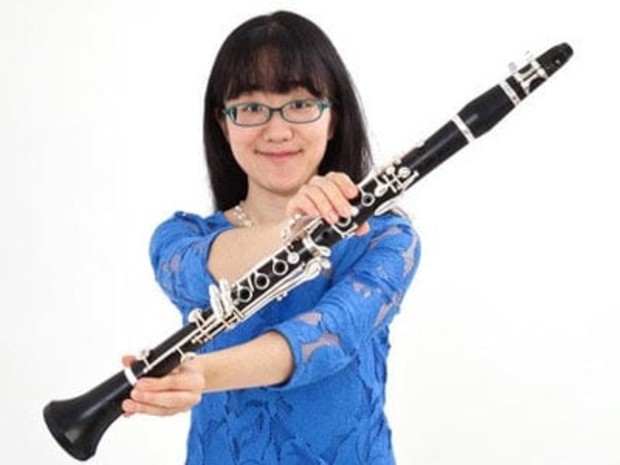
| Anna
Hashimoto’s career encompasses appearances as a
soloist and orchestral musician alongside a commitment to
education. As a soloist Anna has worked with conductors such as Vladimir Ashkenazy, and performed chamber music collaborations with artists such as Michael Collins, Leon McCawley, and the Endellion, Piatti, and Maxwell String Quartets. After winning the Young Clarinettists Competition in Tokyo in 2003, she made her London concerto debut at the age of fifteen with the English Chamber Orchestra at the Barbican Centre, and went on to win international clarinet competitions in Carlino, Italy, in 2009, and Kortrijk, Belgium, in 2010. Following this, her solo career took her to major venues across Europe and Japan, performing concertos with orchestras such as the Brussels Philharmonic, Filharmonie Hradec Kralove in the renowned Dvorák Hall in Prague, and OFUNAM in Mexico. Anna has also given numerous recitals including at the Lucerne Festival and Harrogate International Music Festival. She went on to release three solo CD albums which all received high praise, and has been broadcast on NHK TV and FM, Tokyo FM, ABC Radio and BBC Radio 3, including numerous appearances in Radio 3’s ‘In Tune’, NHK-FM’s ‘Best of Classic’, and NHK TV’s ‘Classic Club’. She has appeared as guest principal clarinet with numerous UK orchestras including the BBC Symphony Orchestra, London Philharmonic Orchestra, Royal Philharmonic Orchestra, City of Birmingham Symphony Orchestra, Royal Liverpool Philharmonic Orchestra, London Mozart Players, Orchestra of the Royal Opera House and the Philharmonia, as well as orchestras further afield such as the Japan Chamber Orchestra, Etihad Chamber Orchestra, and the Flanders Symphony Orchestra. In Japan, Anna is a sought-after soloist, travelling each year for concerto and recital tours. She has appeared as a soloist with orchestras such as Japan Philharmonic, New Japan Philharmonic, Nagoya Philharmonic, Tokyo City Philharmonic, and the Chamber Orchestra of the NHK Symphony with conductors such as Myung-Whun Chung and Martyn Brabbins. She has also collaborated with string quartets such as Kodaly and Prazak Quartets, and cellist Tsuyoshi Tsutsumi for a chamber music series at the Suntory Hall, Tokyo. She is a founding member of the Atéa Quintet, the Associate Ensemble in Residence at the Royal Birmingham Conservatoire. In 2014 they were also Quintet in Residence at The Purcell School. Anna is keen to promote new music, having commissioned numerous works for her recitals, including ‘Hikinuki’ by Richard Bullen, which is now published by the Composers Edition. Anna teaches clarinet and E-flat clarinet at the Royal Birmingham Conservatoire, and often tutors on summer schools such as Sound and Music Summer School for young composers, and the Dartington International Summer School & Festival. Since Spring 2020 she has tutored on courses for the National Youth Orchestra of Great Britain. She has given masterclasses and workshops across the country and judged numerous competitions such as Japan Clarinet Society’s Young Clarinettists Competition and the Cardiff Clarinet Convention. Anna is a graduate of the Royal College of Music Junior Department, The Purcell School, and the Royal Academy of Music where she studied with the world–renowned soloist Michael Collins. She is now an Associate of the Royal Academy of Music, a Vandoren-UK artist, and is represented by Nippon Artist Management Inc. in Japan. She plays on Peter Eaton International model clarinets and basset clarinet. |
||
| Andy Scott | ||
| 10 | Jumbo | 4’36" |
| © Astute Music | ||
| Jumbo is a stand alone
piece of four minutes duration, which was also envisioned
as a first movement, with two other BCE commissions from
Andy Scott, Fujiko and Paquito, completing a
three-movement suite. Jumbo refers to Jumbo Water Tower, a local name for the water tower at the Balkerne Gate in Colchester (the BCE often rehearses and performs in Colchester). The tower was nicknamed "Jumbo" after the London Zoo elephant as a term of derision in 1882 by Reverend John Irvine who was annoyed that the tower dwarfed his nearby rectory at St. Mary-at-the-Walls. The piece itself gives prominence to the larger, lower register clarinets, with an emphasis on rhythmic riffs, Spanish-influenced at times, energy and drive. Commissioned and funded by the Clarinet and Saxophone Society of Great Britain, Colchester Institute, the British Clarinet Ensemble and Charles Hine, Jumbo was given a world premiere by the BCE, conducted by Charles Hine at ClarinetFest Assisi, Italy in July 2013. |
||
| Andy Scott | ||
| 11 | Momento | 6’49" |
| © Astute Music | ||
| Momento was written to
celebrate the 10th anniversary of the formation of the
Südtiroler Klarinetten-Ensemble and the world premiere
was given by both ensembles in Kaltern on 4th September
2017 conducted by Georg Thaler. The composer writes Momento is a 6-minute one movement work that is influenced by the jazz greats Thelonius Monk, Ella Fitzgerald and Dizzy Gillespie, with 2017 marking the centenary of the birth of all three of these inspirational characters and musical innovators. The opening section, Monk, is angular and unpredictable, emerging from a dark and sombre introduction before moving into a minor blues and almost circus-like moments. The slow midsection of Momento, (subtitled) Ella, explores ensemble colours and voicing, whilst allowing space for solo Bb clarinet and bass clarinet to present a blues-in?uenced cadenza. The third and final section, Dizzy, features sustained chords that float above the rhythmic engine room, sounding proud, as if watching Dizzy command, the stage (which I did once in Manchester!). A final release of tension features Eb clarinet writing that explores a similar range to Dizzy’s upper range, and a two-bar two-bar latin-influenced riff is acknowledgement of his pivotal role in the founding and development of Latin Jazz. Momento was commissioned by the Südtiroler Klarinetten-Ensemble with the British Clarinet Ensemble and their directors Georg Thaler and Charles Hine. Grateful thanks are due for generous financial support from the Autonome Provinz Bozen – Bereich Deutsche und Ladinische Musikschulen and the British Clarinet Ensemble. |
||
| Composer/saxophonist
Andy Scott (b.1966) studied at the Royal Northern College
of Music in Manchester, where he now teaches part time.
As a member of the Apollo Saxophone Quartet Andy has
since 1985 performed regularly throughout UK, Europe,
Japan and USA. Andy works as a saxophonist and composer
in a Duo with internationally respected percussionist
Dave Hassell. He also composes for and performs with his
large ensemble, Sax Assault. As a freelance musician Andy
works with the Hallé, BBC Scottish and Philharmonia
Orchestras, Psappha and Apitos. Andy’s compositions reflect his musical upbringing – combining elements of jazz, classical and contemporary music resulting in works that are approachable and accessible for the listener. BBC Radio Three ‘Jazz Notes’ recently broadcast two programmes devoted to Andy’s compositions. September Films, Channel 4 and BBC Radio Two have also broadcast his work. Performances of commissioned works have taken place in USA, Europe and Japan as well as being recorded. Recent commissions include works for; Arabesque Duo, Duo Mandala, Backbeat, Apollo Saxophone Quartet, Kintamarni Saxophone Quartet, James Gourlay, Martin Winter, Equivox and the RNCM Big Band, whilst commissions in 2004/05 include a ‘Double Saxophone Concerto’ for John Harle & Rob Buckland. |
||
| Geraldine Green | ||
| 12-14 | Divertissement | 16’20" |
| © Alea Publishing | ||
| The Divertissement was
commissioned by conductor Peter Morris for his Thameside
Clarinet Choir in London in 1991. The score was completed
in the September of that year and the first performance
followed in November 1991. 1992 saw at least two more
performances of the piece, also in London by the
Thameside Clarinet Choir. The music is tonal, tuneful and
highly rhythmic, with varying colours and textures
throughout. The first movement begins with a grand, slow introduction, leading into the Allegro Moderato, which announces the bright and cheerful main theme. A slower middle section uses the music from the introduction as well as an inner accompaniment figure of the main theme. There are various solos throughout, which would be played by the section leaders. The sunny main theme then returns towards the end to complete the movement. The slow, second movement is the austere, serious side of the work, and seeks to express the more stark, creepy side of a clarinet choir. The textures are piercing, sometimes aggressive, dark and swirling. The third and final movement, Rondo, is jolly, light-hearted and fun, and is possibly the most technically challenging movement of the piece. There are many time signature changes throughout and the music is fast, spiky, humorous and very mischievous. Again, there are various solos for section leaders, especially for the bass and E flat clarinets. |
||
| Geraldine Green was
born in 1967. Her interest in music was awakened when she
was 7 years old, during a holiday when she stayed with a
family of musicians including the composer John Dunn. At
11 she began the clarinet and piano at the Belfast School
of Music, where she studied until the age of 18. It was
during this time that Geraldine’s passion for composition
began, and she began writing her first piano pieces and
studying orchestration with the help and encouragement of
her teacher Gerry Deignan. In 1986 Geraldine went to the London College of Music to study clarinet with David Campbell and piano with Renalda Mackie. Following a 3 year degree course, she then completed a post graduate diploma in Film Music under Francis Shaw. By then the urge to write music could no longer be contained and in the years that followed she wrote a number of works. These included a Recorder Concertino, the Bass Clarinet Concerto, a Septet for string quintet, flute and harpsichord, and a concerto for B-flat clarinet and orchestra. During these years, Geraldine also wrote four musicals for Herne Hill Primary School in London. Throughout the 1990s Geraldine taught clarinet and piano at Ibstock Place School in Roehampton, London, and this soon led to her producing orchestrations and arrangements for the school’s orchestra, band and choir. Through this work she met Peter Morris who commissioned her to write a piece for his Thameside Clarinet Choir. The 3 movement Divertissement was the result. A clarinet quintet, commissioned by Michael Bryant for his clarinet ‘play days’ was soon to follow. After a break in music writing to start a family, March 2008 saw Geraldine return to writing with a seven movement piece for piano, ‘Miscellany’. The year 2009 saw the world premiere of her flute concerto, performed by flautist Gary Woolf (who commissioned the work) and the Chiltern Camerata in High Wycombe, UK, and conducted by composer Simon Lambros. |
||
| Lynne Plowman | ||
| 15 | Helter Skelter | 5’46" |
| © Composers Edition | ||
| The title of this piece
refers to the traditional fairground ride – my memory of
dragging a doormat up a huge metal staircase, the
anticipation of reaching the top, eventually emerging
into the fresh air, the thrill of spinning down the
spiral slide around the outside, and then picking myself
up and doing it all over again. A life lesson maybe…
Most of the music is made from two gestures – climbing
and falling – these gestures are combined in different
ways, sometimes in ‘real time’ and sometimes in
slow motion, and sometimes with a hint of fairground
organ in the background. Commissioned with financial assistance from the Clarinet & Saxophone Society of Great Britain, The RVW Trust, Charles Hine and members of the British Clarinet Ensemble. |
||
| Lynne Plowman is a
composer based in Wales. Her compositions range from
delicate instrumental solos through to dramatic
large-scale vocal, theatrical and orchestral works.
Commissioners and collaborators include Welsh National
Opera, Glyndebourne, the Royal Shakespeare Company, the
London Mozart Players, the BBC National Orchestra of
Wales and the BBC Singers. In 2003, Lynne Plowman won a British Composer Award for her first opera, ‘Gwyneth and the Green Knight’, written for family audiences and described in the Times as “One of the most brilliantly accomplished new operas I have heard in many a year”. A further three operas were created, and equally well-received, in the following years, including commissions from Welsh National Opera and Glyndebourne. During this period, Lynne also enjoyed a fruitful partnership with the London Mozart Players. Commissions included a large-scale choral/orchestral work for Remembrance Day in Portsmouth Cathedral, ‘Cries Like Silence’, and an original film score to the classic silent film ‘The Cabinet of Dr Caligari’. In 2012, an Arts Council of Wales Creative Wales Award supported the further development of Lynne’s orchestral writing. During this period, she refined and developed her working methods, mentored by Sir Harrison Birtwistle. The resulting orchestral work, ‘Catching Shadows’, was premiered by the BBC National Orchestra of Wales. “The result is a thrilling muscularity and sureness of design.” (Wales Arts Review). In 2020, Prima Facie Records released ‘The Beachcomber’ – an album of intimate solos and duos spanning twenty years of Lynne Plowman’s music, described as “a highly original and, through sensitive interpretations, immediately appealing and memorable production" (Remy Franck, Pizzicato magazine). Lynne’s most recent work has an international reach. French contemporary music group, Ensemble Télémaque, commissioned ‘Clarion Call’, for performances in and around Marseille in 2021. Most recently, Lynne travelled to the USA to work with The Merian Ensemble, members of the Atlanta Symphony Orchestra, on a new commission, ‘Small World’, premiered in Atlanta in March 2022. In addition to her composing work, Lynne Plowman is a highly experienced teacher and mentor. She has been a composition tutor at the Royal Welsh College of Music and Drama for nearly twenty years, teaching undergraduate, postgraduate and junior students. Lynne is also the resident composer for the pioneering Dyfed Young Composers scheme, which encourages and supports music composition in schools across West Wales. In 2022, Lynne was awarded the Welsh Music Guild’s prestigious Joseph Parry Award "for her exceptional contribution to musical education in Wales". Lynne Plowman’s music is published by Wise Music Classical and Composers Edition. She is Chair of the ISCM Wales Section, an Ivors Academy Senator and an Honorary Fellow of the Royal Welsh College of Music & Drama. |
||
| Jeffrey Wilson | ||
| 16-18 | Three Haiku | 9’23" |
| © Brasswind Publictions | ||
| Three Haiku fulfills Jeffery Wilson’s long held desire to compose for Clarinet choir. He was particularly pleased to be able to involve his love of the Japanese art form – Haiku – with the simplicity and emotional directness of the texts. Students of the form will know the classical syllabic structure of 5 – 7 – 5 in the poetry, yet there is so much more to the aesthetic and content of Haiku. Whilst the music has much to do with the formal structure of the poems translated below Jeffery hopes the listener can derive something of the narrative too. Movement 1 How I would like To wash the world’s dust With these dewdrops BASHO Movement 2 What’s the butterfly Dreaming As it moves its wings so? CHIYOJO Movement 3 Everyone’s gone home. The fireworks are over. How dark the night is! SHIKI |
||
| Jeffery Wilson is perhaps best known as a composer. He studied at the RCM, Cambridge and Paris and numbers among his teachers John Lambert, Herbert Howells, Gordon Jacob, Aladar Majorossy and Olivier Messiaen. His performances and recordings range from jazz to classical and contemporary and he performs regularly with ‘Saxology’, ‘Triptych’ and for his own project ‘The Reduced History of Jazz’. Jeffery is coordinator and Professor of Composition at Junior Guildhall, Professor of Saxophone at the Royal Military School of Music and examiner for the music faculty at Cambridge University. Of his more than 200 works in the repertoire, about half are published. Jeffery is the director of ‘Environ Music’ a company that promotes learning, special needs awareness and concerts in the UK. He was principal examiner (Jazz) for Guildhall Exams for many years and is now adviser and examiner for Trinity College London. He maintains a long working relationship with Utrecht Conservatorium in Holland. |